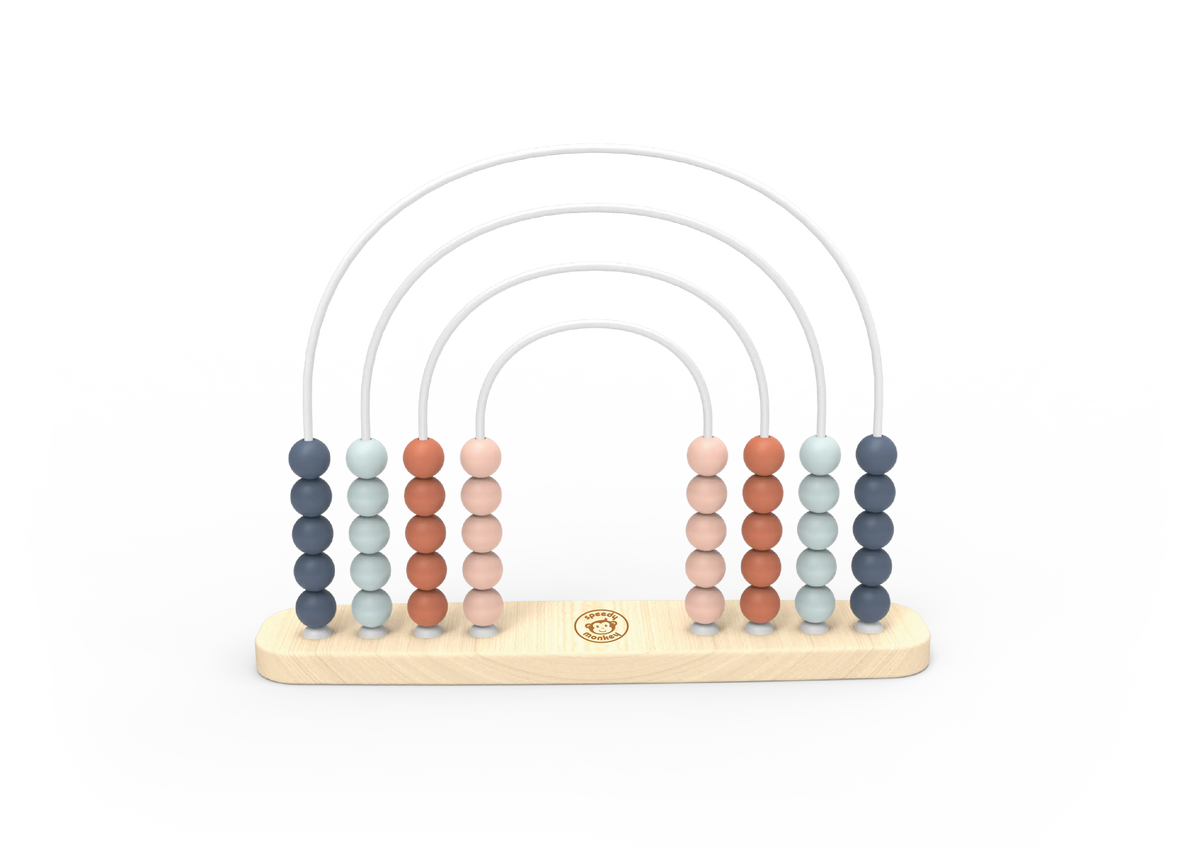
Rainbow Abacus — 4 Arches, 40 Beads
Rainbow Abacus — 4 Arches, 40 Beads
Couldn't load pickup availability
Brand: Speedy Monkey
Rainbow Abacus — push the beads up, and they run back down on their own
Four arches rise out of a solid wooden base, each strung with ten wooden beads in its own colour. Push a bead up the curve and gravity brings it back down to the bottom with a clatter. Which sounds like nothing much until you remember what a one-year-old actually wants from a toy: something that does something, every single time, without a grown-up having to set it up again.
That's the real point of an arch rather than a straight wire. A conventional abacus holds its beads wherever you left them, so somebody has to reset it. This one resets itself.
🌈 One colour to each arch
Ten beads per arch, and each arch has its own colour. At twelve months colour is a far more useful organising idea than number — a child will notice that this row is all the same and that one is all different long before counting means anything. It's also what makes the toy readable from across the room, which is why it tends to live out on a shelf rather than in a box.
✋ Beads that spin as well as slide
The arches are stainless steel rods, and the beads spin freely on them as well as running along. So there are two things to do with one bead: send it down the curve, or sit and twirl it in place. The second is the quiet one, and it's the reason this toy works as well sitting in a high chair as it does on the floor.
🔢 Ten on each arch — and what that is, honestly
Four rows of ten is not a maths abacus. There's no place value here, no tens and units, and a child learning actual arithmetic will need something else. What it gives you is ten, four times over: enough to count along a row, enough to compare one row with another, and enough to introduce the idea that numbers are things you can touch. The counting arrives a long time after the sliding, and that's the right way round.
🌳 Wood and paint
Speedy Monkey design their toys in France and make this one from wood with non-toxic, child-safe paints. It carries UKCA and CE marking.
What we like about it
- It resets itself — beads run back down the arch with no help from you
- Works from the day it arrives, which very few toys at this price do
- Forty beads, ten to an arch, one colour per arch
- Beads spin on the rods as well as sliding, so there's a quiet game and a loud one
- Free-standing on a solid wooden base
- Designed in France, wooden, non-toxic paints, UKCA and CE
Specification
- Suitable from: 12 months
- Contents: wooden base with 4 stainless steel arches, 40 wooden beads — 10 per arch, one colour each
- Size: 31.8cm x 6.9cm x 24.6cm
- Weight: 677g boxed
- Material: wood with non-toxic, child-safe paints, stainless steel rods
- Designed in: France
- Safety: UKCA and CE
- Care: clean with a damp cloth only, no detergents
❓ Frequently asked questions
Will it teach my child maths?
Not in the way a classroom abacus does, and we'd rather say so. Four rows of ten has no place value in it — you can't do tens and units, and an older child working on sums needs a proper counting frame. What this does is make numbers physical for a toddler: ten beads you can push, count and compare. If arithmetic is what you're after, our Shark Abacus is built for addition and subtraction and is rated from three years.
Can a one-year-old use it straight away?
Yes, and that's unusual. Most toys at this price have a gap between buying them and your child being able to do anything with them — stackers need months, puzzles need months. Beads on an arch work from the first attempt, because a swipe of the hand is enough to make something happen.
Is it noisy?
Yes. Forty wooden beads running down steel rods is a cheerful clatter, and your child will discover this within about four seconds. It's not a bedroom toy. If you want the same bead-sliding idea much quieter, the Highchair Bead Coaster is smaller and gentler.
Do the beads come off?
No — they're threaded onto the arches and stay there, so there's nothing loose to lose or to find in a mouth. That's the quiet advantage of an abacus over most counting toys at this age.
Does it stay upright?
It's free-standing on a solid wooden base and weighs a fair bit for its size, so it stays put while a child leans on it. On carpet it's steadier still.
How do I clean it?
A damp cloth only, and no detergents. Painted wood doesn't take kindly to sitting in water — and the beads will go in the mouth, so expect to wipe them.
🔍 Which abacus? It's about age, not price
We sell three, and the cheapest is for the oldest child — so price is a poor guide here:
- Rainbow Abacus — this one, from 12 months. Pure bead-sliding, four colours, self-resetting. The youngest of the three and the only one a one-year-old can use.
- Farm Animal Alphabet Abacus — from 18 months. Letters paired with farm characters, so it's the alphabet rather than numbers.
- Shark Abacus — from 3 years. The only one of the three meant for actual counting, addition and subtraction.
🔴 Other beads on wires
- Wooden Bead Maze — seven beads on a twisting wire, and the cheapest way into bead toys
- Wooden Rocking Beads Maze — a bead maze that rocks, so there are two things happening at once
- Highchair Bead Coaster — suction-mounted for the high chair, and much the quietest of the lot
❤️ From our family to yours
Carefully chosen products for babies, toddlers and parents. Browse more of our toys suitable from 12 months and the rest of our wooden toys — free UK delivery on orders over £25.
Share